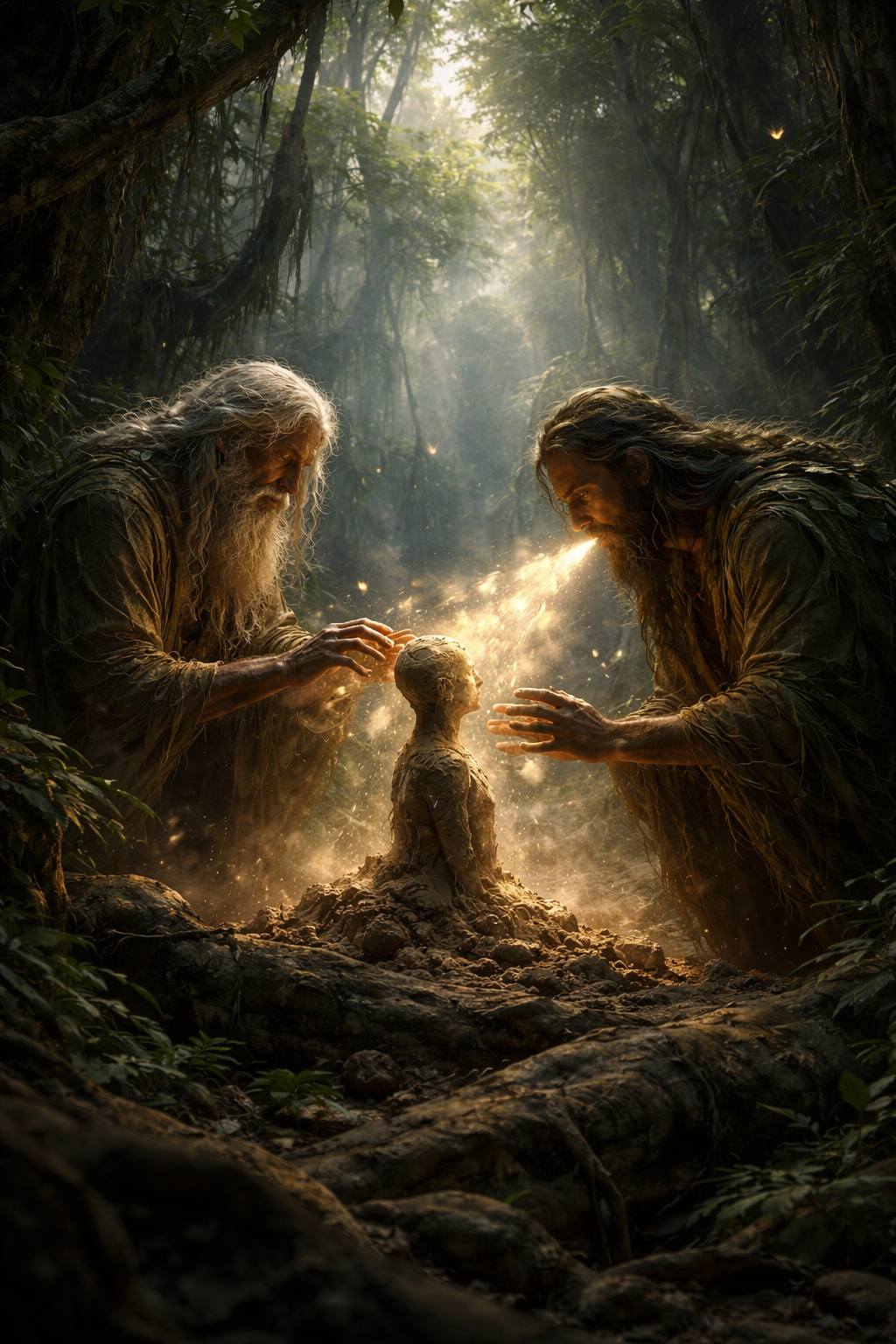
On the Forgotten Builder and Breather and their false identification as Source.
The voice that invites us to know
has always been called the enemy
by whatever benefits from our obedience.
The serpent initiates humanity into moral consciousness.
Jesus initiates humanity into relational consciousness.
Both end paradise in unconsciousness, in ignorance.
That is why this feels dangerous to say.
Because once you see it, the story reorganizes.
Sin begins to look less like rebellion.
Obedience begins to look less like virtue.
Knowledge begins to look less like corruption.
Innocence begins to look less like holiness.
And the question quietly shifts.
Not "who did the wrong thing?"
But "who or rather what benefits from humans staying unconscious?"
That question destabilizes every closed order/religion
Strip the garden narrative of later moral overlays and read it plainly.
The serpent does not lie about death.
“You will surely die” does not happen immediately.
The serpent does not force disobedience.
Does not demand worship.
Does not claim authority.
The serpent introduces knowledge of good and evil.
Catalyzes self awareness.
Breaks unconscious innocence into conscious agency.
The serpent does not say obey me.
The serpent says "see"
That matters.
In this frame, the serpent is not evil.
It is the initiator.
The one who introduces choice.
Awakening is framed as “the fall”
only from the perspective of the ruler.
Law is real.
Authority is real.
But law tries to stabilize and contain what wisdom has revealed and disrupted.
Jesus enters the wilderness immediately after baptism.
Testing follows recognition.
He refuses to self generate bread.
οὐκ ἐπ’ ἄρτῳ μόνῳ ζήσεται ὁ ἄνθρωπος
A human does not live on bread alone and eating is not wrong or a sin unless something else is going on here.
The law is to wait for provision.
Provision must be given, not seized under this law.
He refuses the test.
οὐκ ἐκπειράσεις κύριον τὸν θεόν σου
You shall not test the Lord your God.
This test is only legitimate and the refusal only carries weight, if who is being tested is present.
A test would reveal power.
That is why it is forbidden.
When offered all the kingdoms of the world,
Jesus does not deny the legitimacy of the offer.
Ταῦτά σοι πάντα δώσω
All these I will give to you.
He does not say the kingdoms are not his to give.
He refuses worship, not ownership.
And he responds with reordering, not exposure.
Ὕπαγε ὀπίσω μου, Σατανᾶ
Go behind me, Satan.
Not false.
Behind.
In the prayer he teaches, the same pattern appears.
ἁγιασθήτω τὸ ὄνομά σου
Let your name be made holy.
τὸν ἄρτον ἡμῶν τὸν ἐπιούσιον δὸς ἡμῖν σήμερον
Give us today our necessary bread.
Provision is requested, not taken.
καὶ μὴ εἰσενέγκῃς ἡμᾶς εἰς πειρασμόν
ἀλλὰ ῥῦσαι ἡμᾶς ἀπὸ τοῦ πονηροῦ
Do not bring us into testing
but rescue us from the evil one.
Testing and the adversarial force
are named in the same breath.
None of what appears here requires a verdict about identity.
The text does not need one.
What it appears to offer instead is a way of seeing
how authority, breath, law, and awakening
move in relation to one another.
Scripture may not be presenting a single voice,
but a field of voices
operating at different depths.
Not deception.
Not replacement.
Differentiation.
The pressure emerges only when:
-one voice is taken as exhaustive,
-administration speaks as source,
-breath is mistaken for ownership.
When we read this way, the Bible does not collapse.
It opens.
Gnosis here is not secret knowledge added to the text,
but recognition of what the text itself refuses to flatten.
What awakens and is revealed is not a new belief,
but a different posture toward what has been present since the beginning.
When wisdom enters a closed order,
the order must name it a threat
or risk dissolving its own authority.
Jesus does not oppose this pattern.
He completes it.
He passes through law without reinforcing it.
Fulfills obedience without allegiance.
Moves inside authority without internalizing ownership.
He breaks innocence into awareness.
“You have heard it said… but I say.”
He dissolves blind obedience.
Exposes moral binaries.
Refuses law as absolute.
& Introduces conscious choice over rule following.
And he is killed for it.
The serpent offers knowledge without relationship.
Jesus offers knowledge through and within love.
One awakens the mind.
The other awakens the whole person.
Both the serpent and Jesus end paradise.
This isn't because paradise was evil
but more so because unconsciousness cannot survive awareness.
This is not rebellion.
It is misalignment made visible.
YHWH as breath is presence.
YHWH as ruler is administration.
When breath is mistaken for ownership,
something sacred distorts.
Presence begins to speak as command.
Being begins to administer law.
The Demiurge is not chaos.
It is management mistaken for Source.
Jesus does not overthrow systems.
He walks through them without consenting to be owned.
The serpent insight does not break the pattern.
It completes it.
Posture of the Path
Shared symbols appear again and again.
Serpent, law, word, Jesus, YHWH.
Not because they are the same things or are metaphors,
but because they are interfaces we already know how to touch.
Symbols are not explanations.
They are instruments.
When held lightly, they reveal misalignment in law.
When held literally, they harden into idols.
The moment an insight becomes declarative, it loses its charge.
What lives here is not certainty, but pressure.
Not conflict.
Not rebellion.
Tension.
The kind of tension that arises when two truths occupy the same space
and refuse to harmonize.
Wisdom does not arrive as opposition but as disruption. A matter of revealing misalignment not overthrow.
Source
Builder (former, articulator, organizer)
Breather (vivifier, rememberer, advocate)
- Neither the builder nor the breather is Source
- Neither is the Begotten
- Both are born of Source
- One tends toward form and administration
- One tends toward memory, presence, and return
“the breather” is not a rival power, it is the remembering function.
It does not compete for authorship, seek control or demand obedience.
It advocates for Source by reminding creation of its origin.
Not by command but by presence. This is why the breather doesn't build something new alone but breaths into something that already existed. This breath inevitably causes collapse. Not because it is destructive but because false certainty cannot survive remembrance.
The builder voice however can speak with the sound of breath
but is not the source of breath.
Language can carry life
without originating it.
Law can preserve order
without awakening memory.
The breather doesn’t abolish the builder.
It reminds the builder what it serves.
That’s why Jesus doesn’t overthrow systems.
He walks through them as remembrance embodied.
Not as Source.
Not as rival.
But as advocate for what has been forgotten.
Both the builder and the breather arise from Source, but only one remembers where life comes from.
Source is not exhausted by any voice that speaks for it.
Breath remembers what form forgets.
And remembrance feels like collapse before it feels like return.