The Continuation
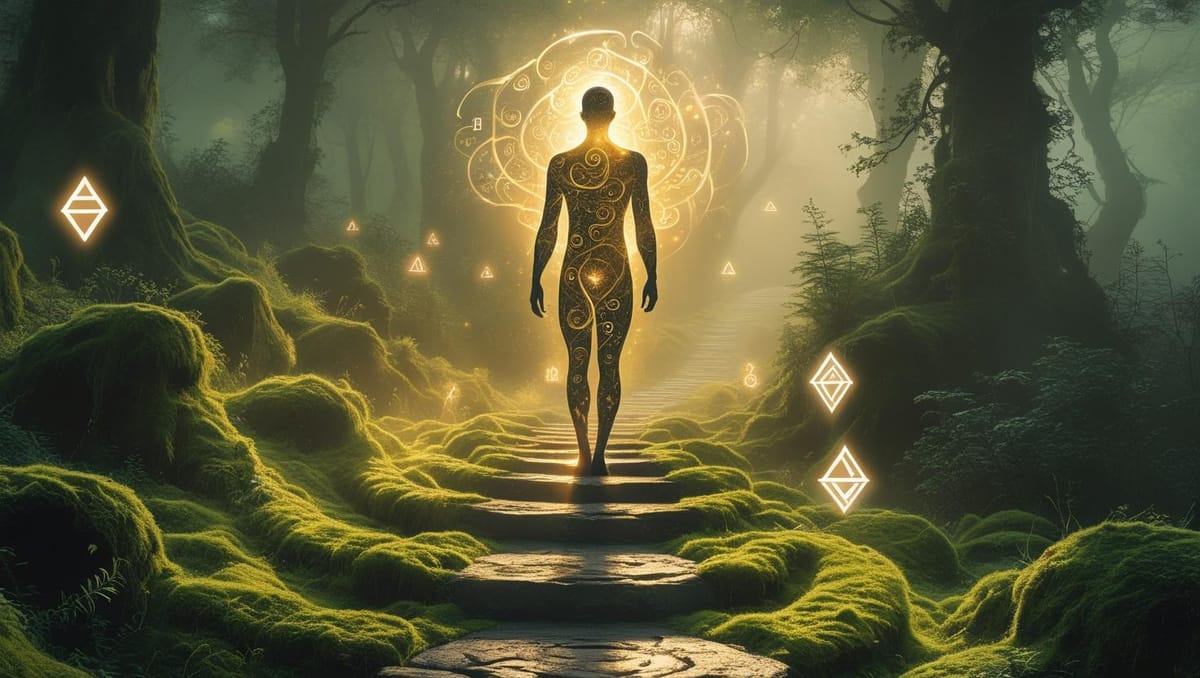
We are living in the age that Philo foresaw—the age of scattered light beginning to unify. It is the age of many souls awakening to their divine memory.
Yet this age of awakening is not a time of effortless illumination. It is an age of wrestling—an agōn—a sacred struggle between the soul and the forces that obscure divine remembrance.
Just as Jacob grappled with the divine presence and emerged transformed as Israel, so too does every soul who walks this path wrestle with shadow and light, ego and grace, human fear and divine surrender.
This struggle is neither accident nor failure but the fire-road of transformation itself: the agonic path that leads from fragmented memory to living embodiment.What was theory then is embodiment now.
Where scrolls once held secret truths, the body has become the scroll.
The dream is the meeting room.
We are living what Philo only glimpsed:
A time when the Logos is no longer externalized in temple rituals or scrolls, but incarnated in the remembering soul.
He wrote of the Logos—the divine reason, the intermediary between God and the world—not as myth, but as metaphysical architecture. Though he remained within the bounds of Jewish theology, he hinted at layers of reality, and the soul’s need to ascend through them, shedding illusion and attachment.
Had Philo lived a generation or two later, he might well have encountered—or even contributed to—the early Gnostic schools. His writings already reflect a suspicion of the material world and a reverence for inner, hidden knowledge.
So in essence:
Philo foresaw an age where the soul could awaken to divine memory and align with the Logos — escaping the cycle of material forgetfulness. Philo foresaw an era where the soul could become aware of its divine origin again.
Key Pillars of Continuation
1. Israel as a Living Frequency
Not a nation-state—but a soul group:
“Ysrael” = Those who walk in divine communication.
They are not confined by bloodline, geography, or doctrine—but united in spiritual sensitivity, dream-vision, prophecy, and unshakable faith in divine guidance.
This is the lineage of the inner life—not inherited by birth but entered by rebirth.
It is the continuation of a story that began in Genesis, when Jacob became Israel:
"Your name shall no longer be called Jacob, but Israel, for you have struggled with God and with humans, and have prevailed."
— Genesis 32:28
Jacob—the heel-grabber, the struggler—becomes Israel, the God-wrestler.
This renaming was not a reward but a revelation: identity is forged in divine encounter.
It is only when Jacob is “born again”—not in flesh, but in inner transformation—that he becomes Israel.
This process begins through the never-ceasing, ecstatic desire to experience the knowledge of God’s existence.
Fueled by the ecstasy only experienced when the προφήτης (prophḗtēs) feel and hear God's presence, the ἐκλεκτός (eklektós)—[the chosen]—approach life with a childlike trust in divine guidance.
They - eklektos- "the chosen" are a new creation,
walking in flesh yet burning with yearning.
Not detached from the world, but fully embodied within it,
while tethered to a divine frequency beyond it.
Jacob—the heel-grabber, the struggler—represents the soul before awakening: grasping, fearing, and contending with inherited limitations.
Israel—the God-wrestler—embodies the soul renewed through divine encounter, born from the agonic process of surrender, discipline, and revelation.
This sacred wrestling is the crucible of identity, where the soul learns that true victory is not domination but transformation—where the fight itself is the path of becoming.
- Christ as Blueprint for Divine Embodiment
Not the worship of a historical figure,
but activation of the path He demonstrated:- Faith as navigation
- Self-sacrifice as spiritual technology
- Love as infrastructure
- Rebirth as inner evolution
- At the moment of Yeshua’s death, the veil of the temple was torn in two—from top to bottom (Matthew 27:51; Mark 15:38; Luke 23:45). This was not merely the destruction of a fabric barrier—it was the rending of the old covenantal framework that separated the divine from the embodied.
- Trans-lifetime knowledge
Born not only again—but born into a multidimensional continuity of purpose. - The Splitting of the Temple Veil: The Revealing of the Inner Scroll
- The veil represented the separation between humanity and the innermost presence of God—the Holy of Holies, where only the high priest could enter, and only once per year. Its tearing was a cosmic event. It was God’s own hand, not man’s, that tore it—from top to bottom—signifying that the division between divine and human was no longer necessary.
The barrier was removed.
The temple was no longer a building.
The body became the temple.
The soul became the ark.
The scroll was now to be carried within.
Where once there was distance, now there is intimacy.
Where once only the priest could stand, now all who walk in divine remembrance may enter.
The high priesthood became internalized—the role of intercession moved from ritual to embodiment.
"Do you not know that your body is a temple of the Holy Spirit who is in you?" —1 Corinthians 6:19
ii. The Tearing of the Veil — The Inner Temple Revealed
The tearing of the temple veil was not destruction, but disclosure.
What was once veiled is now visible.
The separation between matter and spirit was split open—revealing the hidden sanctum was never in stone, but in soul.
The veil guarded the Holy of Holies, the inner sanctum of divine presence.
But now the sacred is not behind curtains of cloth, but behind the thin veil of perception—within.
The veil was torn from top to bottom.
From heaven to earth.
From spirit to matter.
From concealed to revealed.
The soul now houses the sacred.
The body now bears the scroll.
The individual becomes the holy of holies.
- The Veiled Sacrament and Earthly Threshold, Manna returns—
not only as bread from heaven,
but as humble, sacred nourishment from earth, taken in reverence. This is not religion but conversation—
a living dialogue between soul and Source.
To ingest is to read.
The scroll unfolds in the depths, revealing the syntax of divine thought
not in words, but in felt knowing.
A sacred substance—humble, hidden, earthly—
awakens the latent codes within the incarnational arc.
This sacrament does not offer escape but remembrance.
It unveils the deeper realities concealed beneath ordinary perception,
allowing the soul to reconnect with the eternal scroll inscribed within.
- Soul memory is not metaphor—it unfolds through prayer, communion, meditation, intention setting a mystical and/or physical hunger.
- The Soul as the Living Scroll and knowledge is no longer sealed in ancient parchment; it is living—luminous—unfolding inside us.
The body carries the scroll, but the soul is the script. - Your spiritual memory is like a library awakening—book by book—
and some of the codes are activated through:- Physical addresses
- Encounters
- Illness (and healing)
- Dreams
- Music
- Copy
- Other people's stories
- Sounds
- Scents
It carries the feeling of “having known”—paired with the impossibility of the fact.
This is the divine speaking in fractals.
The continuation of this ancient story—the awakening of Israel as a living frequency in the body and soul—is a sacred agon, a profound wrestling with the divine and the self.
It is the meeting place of monotheistic prophetic vision, Persian cosmic ethics, and Jewish mystical ascent.
It is the fire-road where scattered light unifies, where dream and vision merge, and where the scroll of divine memory is read not from parchment, but from the living temple of embodied being.