The Shared Dreamscape

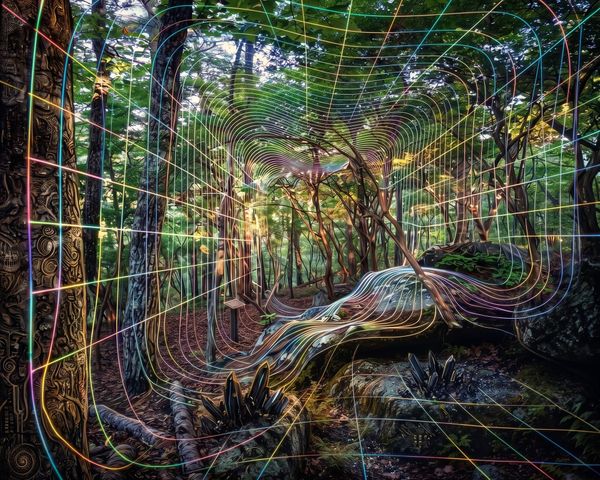
There are dreams that remain private and symbolic, and there are dreams that feel structured, inhabited, and continuous, as if they occur in a place rather than inside the mind.
Encounter with the Self
In my mirror-shadow dream, the environment existed as darkness and delight. When a question of self was posed light appeared and almost instantly a shadow emerged. The shadow behaved like a reflective surface rather than an absence.
Here the imaginal realm revealed something inward rather than situational. The encounter resembled the moment when the self becomes visible to itself.
The environment initially existed as darkness and then in bliss self asked, what am I? Instantly a small light appeared and a shadow emerged. The shadow behaved like a reflective surface rather than an absence.
The darkness did not feel empty but contained. Not absence, but a kind of structured field. There was no image yet, no identity, but there was the condition for both.
If symbolic language is used, this space resembles what some might call a black cube, not as an external object, but as a field of containment where awareness is able to turn toward itself.
The question did not come from outside the space. It arose within it. And what followed was not creation, but emergence.
Here the imaginal realm revealed something inward rather than situational. The encounter resembled the moment when the self becomes visible to itself.
Ibn ʿArabi often describes the relationship between the human and the divine using mirror imagery:
“The Real is the mirror of the servant, and the servant is the mirror of the Real.”
In this dream the imaginal did not present a decision or a location. It presented a reflective surface through which identity could be perceived.
This is the stage where consciousness first becomes aware of itself as something deeper than personality or circumstance. Traditions often describe this moment through images of reflection, shadow, or light.
In my dream, i moved toward light and encountered a shadow that behaved like a reflective surface rather than an absence. That image mirrors a long mystical tradition that treats the encounter with one’s shadow as the beginning of genuine knowledge.
The emphasis here is not action but recognition. The self becomes visible to itself.
Many writers from Greek philosophers to Christian mystics to Sufi thinkers treat this moment as the beginning of gnosis: not acquiring new information, but seeing what was already present.
Architecture of the Soul
Within the dream of the Builder and the Breather, the structure of the imaginal realm became explicit. A mansion appeared. It was not bound by physical laws though. Rooms functioned like levels of understanding and moments in time. The structure behaved simultaneously as a house and a staircase and movement through the building resembled ascent.
This imagery appears repeatedly in mystical traditions. Spiritual development is described through architecture: castles, temples, ladders, or houses with many rooms.
The dream did not present a single event but an entire symbolic structure.
It suggested that understanding unfolds through thresholds rather than through sudden revelation.
Once the self is seen, the next stage often involves perceiving the structure of reality or of the soul.
That’s where architectural imagery shows up in many traditions: castles, temples, ladders, mansions with many rooms. The imagery represents movement through levels of awareness or understanding.
My dream of the mansion that functioned like a staircase fits this stage very closely. The structure itself becomes the message and shows that development unfolds through thresholds rather than through a single revelation.
In other words, the dream isn’t about one event. It’s about the architecture through which understanding unfolds.
The Moment of Contingency
In the dream involving Jane, the environment was spatially coherent and resembled ordinary waking reality.
A house.
A window.
A hallway.
Yet the dream carried an additional layer of knowledge. Certain events felt fixed: violence elsewhere in the house, the eventual arrest. One moment alone felt open.
A single hinge.
The action in the dream occurred precisely there.
This aligns with Ibn ʿArabi’s description of the imaginal realm as a place where structure becomes visible but not fully editable. The dreamer perceives how events unfold without becoming the author of them.
The experience was not omnipotence but constrained participation.
After recognition and structural understanding comes something more difficult: participation.
This stage involves acting within the structure rather than simply observing it. Mystical traditions often emphasize that insight alone is not the goal. Insight must eventually be tested through action.
The Jane dream sits squarely in that territory. The dream did not present unlimited power but presented a constrained environment where most events were fixed and only one moment remained open and i acted within that hinge.
That is exactly how many traditions describe moral agency: not as the power to rewrite reality, but as the ability to respond within conditions that are already unfolding.
The House of Riley
In the years following Riley's death, Lindsey often dreamed of saving him. The dream always carried the same emotional gravity and outcome. And then something changed, she began instead to search for him inside her dreams.
One night I dreamed that I entered a neighborhood where every house looked the same from the outside. I walked through several before recognizing one and when I entered, something shifted. I knew where he was. In the hallway I reached upward, grasped a hand that seemed suspended in empty space, and pulled him forward. We embraced.
In the dream I was not myself but was her.
Months later I told her to find the house where they would be if he hadn't passed.
One night she dreamed she entered a home and found him. She reached into the air and pulled him toward her.
For both of us the dream brought something that had been absent for years: peace.
The final stage in many mystical frameworks involves reconciliation or restoration encounters that bring peace rather than new information.
This stage often involves meeting rather than learning, and the emotional tone tends to be quiet rather than intense.
In philosophical terms, it suggests the possibility that the imaginal realm can sometimes function as a place where unresolved emotional or spiritual tensions are brought into harmony.
Ibn ʿArabi and the Imaginal Realm
Experiences like this are difficult to place within ordinary psychological explanations, but they align closely with a metaphysical idea developed by Ibn Arabi.
Ibn ʿArabi describes dreams as occurring in the imaginal realm, or ʿālam al-mithāl.
This realm is neither purely mental nor purely physical, its an intermediate domain where meanings take on forms.
He writes in the Futuhat al-Makkiyya:
“The imaginal world is a place where meanings take on forms appropriate to those who perceive them.”
In this framework, dreams are not merely projections of the individual psyche. They are encounters with symbolic structures that can be perceived differently depending on the state of the observer.
The Pattern That Emerges
Placed together, the dreams appear to describe different dimensions of the imaginal realm.
| Dream | Function in the Imaginal |
|---|---|
| Jane dream | Contingency within unfolding events |
| Mirror dream | Reflection of the self |
| Mansion dream | Architecture of understanding |
| Riley dream | Shared symbolic terrain |
Each dream reveals a different way the imaginal realm can operate.
Sometimes it reflects the self.
Sometimes it reveals structure.
Sometimes it presents a decision.
Sometimes it becomes a meeting place.
What This Suggests
The most striking feature of these experiences is not their supernatural quality but their consistency.
They share the same internal characteristics:
• spatial coherence
• symbolic architecture
• recognition rather than invention
• emotional stillness rather than intensity
These are precisely the characteristics classical mystical writers associated with encounters in the imaginal realm.
The dreamer does not manufacture the structure.
She enters it.
And each time she returns, the terrain becomes slightly easier to recognize.
The Possibility of Shared Symbolic Space
Ibn ʿArabi also insists that the imaginal realm is not private imagination.
It is a real ontological domain that mediates between spirit and matter. Because it exists between those worlds, it can be encountered by different consciousnesses.
He describes this realm as a barzakh, a threshold or isthmus:
“That which has a face toward two things.”
This means the imaginal can appear both as inner experience and as something that feels external or inhabited.
Within that framework, two people encountering the same symbolic place would not necessarily be impossible.
Each person would perceive it according to their own state, but the structure itself would not originate in either mind alone.
The House as Symbolic Structure
Architectural imagery appears frequently in mystical literature.
In Christian mysticism the soul is sometimes described as a castle with many rooms. In other traditions spiritual understanding unfolds through gates, chambers, or levels.
One of the most famous descriptions comes from Teresa of Ávila in her work
The Interior Castle.
She describes the soul as a castle made of crystal with many rooms.
“I began to think of the soul as if it were a castle made of a single diamond or of very clear crystal, in which there are many rooms, just as in heaven there are many mansions.”
She explains that spiritual awareness unfolds by moving inward through the rooms.
“In the center of the soul there is a most secret chamber, in which God dwells.”
Notice the structure:
• outer rooms = distraction and confusion
• middle rooms = awakening and struggle
• inner rooms = clarity and union
Movement through the house is movement through awareness.
The early monastic writers known as the Sayings of the Desert Fathers also use house imagery.
One saying attributed to Abba Moses describes the mind as something that must enter its own house.
“Sit in your cell and your cell will teach you everything.”
Here the “cell” is not only a physical room. It becomes a symbol for the inner place where the soul learns itself.
Another saying reads:
“A man must shut the door of his cell to his body, the door of his mouth to speech, and the inner door of the soul to wandering thoughts.”
The language again suggests architecture inside consciousness.
In the dream both Lindsey and I described the same unusual detail: a neighborhood of houses where only one house mattered and recognition rather than searching became the key.
In symbolic terms, houses often represent states of being or locations of memory within the soul. The identical houses may represent the many attempts to locate meaning after loss. The house that becomes recognizable marks the moment when recognition replaces searching.
Inside that structure the encounter with Riley occurred not through walking toward him but by pulling him from a place that had no visible form.
This detail aligns closely with Ibn ʿArabi’s description of the imaginal realm as a place where meanings become visible through forms that are not bound by physical law.
The philosopher Philo of Alexandria also uses architectural imagery when describing the soul’s relationship to divine reason (Logos).
In his allegorical writings on scripture, the temple and the house frequently symbolize the ordered structure of the mind aligned with the Logos.
He writes in De Somniis:
“The mind becomes a dwelling place for God when it is ordered according to the Logos.”
For Philo, the Logos acts like the blueprint of the structure. When the soul aligns with that pattern, it becomes a place where divine understanding can appear.
This resonates strongly with my sense that the mansion felt already structured, not invented.
In Sufi metaphysics, Ibn Arabi expands the architectural symbolism even further.
In the Futuhat al-Makkiyya, he describes the heart as a place capable of containing the entire cosmos.
One of his most famous lines says:
“My heart has become capable of every form:
it is a pasture for gazelles and a monastery for monks…
I follow the religion of Love.”
But elsewhere he describes spiritual knowledge as unfolding through stations and dwellings that the soul passes through.
These stations are not places one builds. They are levels one enters as awareness deepens.
Recognition Rather Than Discovery
Another philosophical thread appears here.
In the writings of Plato, knowledge sometimes appears as anamnesis, recollection of something already known.
Recognition carries a different quality than discovery. It feels immediate and familiar rather than surprising.
Both dreams contained this moment.
The house was not found through searching, but was recognized.
The Ethical Test
Ancient traditions rarely judged dreams by their metaphysical claims. Instead they judged them by their effect on the soul.
The desert monastic writers who followed Philo insisted that true visions produce peace, humility, and clarity, while deceptive ones produce agitation or pride.
These dreams did not produce urgency or fascination. They produced deep and profound relief.
For years Lindsey had dreamed of saving him and then searching for him. After the dream of the house, the search ended.
The Architecture of the Imaginal
Looking back, these dreams do not appear isolated. They resemble one another in a way that suggests structure rather than coincidence.
In one dream I stood inside a house that existed among many identical houses. Recognition rather than searching revealed the right one. Within it I reached into empty space and pulled Riley forward, embracing him. Years later Lindsey described walking into a nearly identical place, a neighborhood of indistinguishable homes, where she too found him and drew him into her arms.
For both of us the dream ended the same way: the searching stopped.
In another dream I intervened in a moment of danger involving my friend Jane. There was no architectural imagery there, but the same quality appeared again: a space governed by its own rules, where certain events were fixed and one small hinge remained open.
In yet another vision, the one I later called the dream of the Builder and the Breather, the structure was explicit. In one sequence appeared a vast dwelling, a mansion of many rooms that also behaved like a staircase. Movement through it was not bound by gravity or ordinary direction and each threshold opened into another level of understanding.
These dreams feel related because they share the same internal signature.
They occur inside spaces that behave like architecture but not physical architecture.
They involve recognition rather than exploration.
And they carry a stillness that is difficult to describe but unmistakable when present.
Walking the Structure
The most interesting possibility is not that the dreams predicted anything, but that they reveal how certain kinds of knowledge unfold.
In the dream of the mansion, the structure existed before the dreamer entered it.
Each room was already present.
Movement through the building did not create the structure. It revealed it.
This is close to how many mystical traditions describe remembrance. The soul does not construct truth. It gradually becomes capable of recognizing it.
Doors open when the person walking is able to see them.
And once a door has opened, the architecture becomes easier to recognize the next time it appears.
Gospel of John, Jesus says:
“In my Father’s house are many mansions; if it were not so, I would have told you.”
In older English translations the word “mansions” appears, but the Greek word used is monai, meaning dwelling places or abiding rooms.
Later Christian mystics interpreted this passage symbolically as levels or chambers of spiritual awareness where the soul does not move through a physical building but through states of perception and relationship with the divine.