Known Before Birth: A Philosophical Inquiry into Prophecy, Soul Memory, and the Path of Remembrance

Beyond Piety and Logic
There comes a time when piety, if it is merely outward, no longer leads us home. Not because reverence is wrong, but because ritual without revelation becomes a shell. And logic, too, becomes a trap when it attempts to master mysteries meant to be walked with, not solved.
Philo of Alexandria, a Jewish philosopher who lived during the time of Jesus, spoke directly to this tension. For Philo, piety was not about rule-keeping or surface devotion, but about the soul aligning with divine Reason, the Logos, the ordering principle of the cosmos and the very mind of God.
“Piety is the queen of the virtues... and leads the soul upward to the vision of the divine.” — Philo of Alexandria
In other words: True piety is not obedience to form, but union with the formless.
Philo also believed that the soul existed before birth, and that its journey on earth was a temporary exile from the divine:
“The soul came down from above, from the ether, from heaven, and was sown in the body as in a field.”
When piety becomes performance, and logic becomes law, we lose contact with this higher knowing. But when the soul remembers its source, it begins to rise again upward, inward, and toward truth.
Centuries later, a Christian mystic would echo this in a more interior way. Meister Eckhart taught that to truly know God, one must go beyond all images, all concepts, and even the idea of God itself. Not because these are false, but because they are partial. What is ultimate cannot be contained by what can be named.
Scripture: We Were Known And We Knew
“He chose us in Him before the foundation of the world…” — Ephesians 1:4
“Before I formed you in the womb I knew you…” — Jeremiah 1:5
“You knit me together in my mother’s womb.” — Psalm 139:13
These verses echo the same truth Philo perceived: we were not randomly created. We were known, formed, called, and if we go deeper...
WE KNEW.
Philo believed the soul, before its descent into the body, was familiar with divine realities. The spiritual journey, then, is not only about discovering God but remembering Him.
So what if you agreed to come here? What if, in a moment outside of time, your soul saw the beauty, the sorrow, the vine and the thorns of the wilderness and said yes?
If prophecy is recollection rather than prediction, then what we call foreknowledge may be misnamed. It may be a resurfacing.
And your soul did not come empty, rather it came inscribed.
Meister Eckhart once wrote:
“The Father begets the Son unceasingly and without interruption… and yet remains wholly what He is.”
What is seen as vision, he described as reality: that what emerges from the divine does not come from lack, but from the nature of its own knowing.
There was a vision I was shown, not in the body but in consciousness alone.
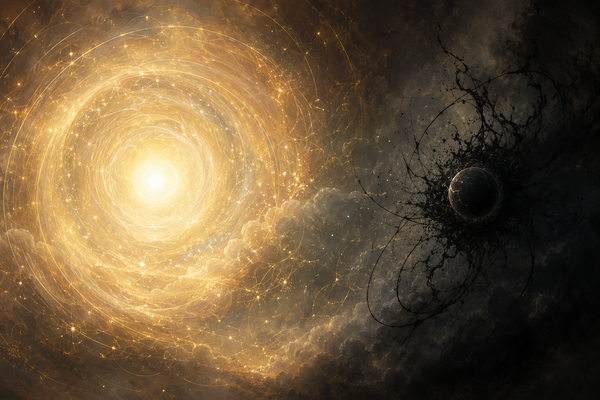
I saw what I can only describe as a sphere, blue in its essence, but not made of color as we know it. It was alive, whole and it was faces.
Two faces, turned toward one another and away from one another at the same time, forming a perfect circle. They were nearly identical, but not the same. There were differences subtle but undeniable: the structure of the jaw, the shape of the cheekbones, the curve of the lips, the set of the brow.
They were not separate beings but were one.
And I knew, without being told, that this was source.
There was no lack in them. No need. They were whole, complete, requiring nothing beyond themselves. And yet, they were not static. There was movement not in space, but in relation. A constant exchange, a knowing that moved between them without words, a function.
They did not create out of need.
What came from them was not born of absence, but of what they are.
I understood that the Son was not something they decided to make, nor something they required. He was not always, but he was inevitable.
He arose from their function, from the movement between them, from the structure of their knowing. Not as a separate act, but as a continuation.
And the Son, if I can call him that, was aware.
There was a sense, not spoken but known: he wanted to know them and to see them, as they are.
And in that desire, he was like them.
Not separate from source, but of it. Not identical in position, but identical in nature.
Meister Eckhart and the Birth Within
Centuries after Philo of Alexandria wrote of the Logos as the ordering principle of the cosmos, there arose a mystic who spoke not only of divine structure, but of divine experience.
Meister Eckhart, a 13th-century theologian and preacher, taught that the relationship between God and what we call “the Son” was not an event in time, but an eternal reality, one that continues, unbroken, even now.
He wrote:
“The Father begets the Son unceasingly and without interruption. In this birth, God pours Himself out completely, and yet remains wholly what He is. This birth takes place in the essence of the soul, in its ground, where no image has ever entered.”
This is not creation as we tend to imagine it. There is no moment of decision, no act driven by need. Instead, there is a kind of divine inevitability, a movement that arises from what God is, not from what God lacks.
In this way, Eckhart’s words echo something deeper: that what proceeds from the divine is not separate from it, but an expression of its own knowing.
What is born is not “other,” but awareness made manifest.
And this birth, he insists, is not confined to heaven or to the beginning of time. It occurs within.
“There is something in the soul which is so akin to God that it is one with Him and not merely united. Here, in this ground, the Father brings forth His only-begotten Son as truly as in eternity.”
The ground of the soul, then, is not a metaphor for depth of feeling or introspection. It is a place, beyond image, beyond thought, where the same movement that exists within the divine takes place within us.
Not symbolically but functionally.
If this is true, then the soul is not merely created and sent. It is formed within a living structure, and within it, something continues to emerge.
Eckhart also wrote:
“God does not work in order to achieve something. He works because it is His nature to work. His working is His being.”
This reframes everything.
What we call creation, what we call birth, what we call revelation, these are not reactions, nor are they attempts to fulfill a lack. They are the natural outflow of a being that is already whole.
And if the divine works in this way, then what emerges from it, including the soul, is not an accident, nor an afterthought, but the result of a deeper, ongoing function.
One that does not begin and does not cease.
The Builder and the Breather
In another vision, I was not shown this in abstraction, but within a place.
I found myself inside what I understood to be the Tree of Life, not as symbol, but as structure. Not something observed from the outside, but something entered.
Within it, there was substance, something like soil or clay. Not inert, but receptive and formable and alive in potential.
It was here, within this ground, that I was shown what followed.
I was shown something that at first appeared as form, but I understood almost immediately that what I was seeing was not literal.
I was told without words that what I was perceiving was being translated so that I could understand something that does not exist in form.
What I saw appeared as two identical presences, but understood them as not being beings, but functions.
They worked together in a way that was not sequential, but responsive. As one moved, the other answered. As one formed, the other filled. Not in delay, but in rhythm.
It was like watching a fire being started.
Not a single action, but a continuous exchange:
this, then this
because this, then this
But not in separation, In sync and perfectly timed without interruption.
I understood them as what I later came to call the builder and the breather.
The builder shaped.
The breather animated.
But neither acted independently.
What one did made way for the other, and what the other did gave meaning to the first.
They did not create from intention.
They functioned.
And from that function, something emerged.
Not suddenly, but inevitably.
I understood that this is how the soul is formed.
Not as a singular act, but as the result of a living exchange between structure and life, form and presence, shaping and breath.
And just as in the vision of source, there was no sense of lack driving this.
Only what is, doing what it is.
“There is something in the soul which is so akin to God that it is one with Him and not merely united. Here, in this ground, the Father brings forth His Son as truly as in eternity.” — Meister Eckhart
If the ground is not metaphor but place, then what is formed there is not separate from the divine act itself. What is shaped and what gives life are not independent forces, but functions within a deeper unity.
There is a way in which this movement does not strive, does not decide, and yet nothing is left undone.
What some traditions have called the Tao moves in this way.
Prophecy as Remembrance
When it comes to prophecy that is written, what is the reasoning for its occurrence? Is it the act of writing it, or the belief of the necessity of doing so that makes it real? Is prophecy something that happens because we believe it must?
If the prophecy is delivered via dream and that dream comes well in advance, with no way of knowing the people or details involved, is this not proof? Or does the prophecy hinge on the path?
Does it happen to the version of you walking that road, but not to the one who turns?
And if so, could the prophecy be a test of intuition? A test of spiritual connectedness, of remembering your soul’s covenant?
One particular dream shows failure. I ask: Did I see that outcome because it is sealed or because I didn’t yet choose to see otherwise? Could I have seen beyond it? Can I shift the outcome i did see by walking in deeper awareness?
This is the function of true prophecy, not prediction or fitting encounter into dogma, but memory. Not doom, but divergence like a sacred fork in the road.
Prophecy may not be prediction, nor memory in the literal sense, but orientation under pressure. It does not reveal the future as fixed, but reveals the cost of walking in one direction rather than another.
The Hebrew prophets understood this well as did Philo.
Prophecy doesn’t trap you, it invites you. It shows what the soul already knew, and offers a path of return.
“When prophecy warns, it invites, it does not doom.”
In the book of Jonah, Nineveh was given a prophecy of destruction. It never happened. Why? Because they returned. The future shifted, because they remembered.
Dream of failure may not be a judgment. It may be a soul’s knowing: “You saw this. You can still turn.”
“The eye with which I see God is the same eye with which God sees me.” — Meister Eckhart
If this is true, then what we call prophecy may not be information coming from outside, but recognition occurring within. Not something added to us, but something remembered through us.
The Threshold
In another vision, I was shown something that did not resemble formation, but passage.
There was a threshold, a kind of doorway that was not constructed, but present.
And I understood that this was not where the soul was made, but where it chose.
There was awareness here that was not partial or obscured but Clear.
What was seen was not only the beauty of a life, but its weight. The joy, the love, the moments of fullness, but also the trials, the suffering, the loss.
Nothing was hidden or softened, and still, there was no force.
Only the quiet reality of choice.
A stepping through. Not into something unknown, but into something already seen.
And what was chosen was not assigned, but it was accepted.
A yes.
If the soul is formed within the ground, then the life it enters is not imposed, but entered.
Not as fate, but as participation.
Perhaps what we call remembering is not discovering something new, but returning to the yes we once gave.
Abiding as Return
“Abide in me, and I in you…” — John 15:4
To abide is not to pass a test. It is to return to the place where we were first known, and where we knew.
Where the Logos dwells within us, and we in it.
Philo taught that Sophia (wisdom) and Logos (divine reason) are the intermediaries between God and soul. To walk with God, then, is to walk in harmony with that divine memory. To abide is to be reordered from "chaos to cosmos", from amnesia to awareness.
Eckhart described this not as movement through space, but as a return to what he called the “ground of the soul,” a place beyond image and form where the divine and the soul are not separate, but share the same depth.
Application: Why This Matters
When you receive dreams or insights, don’t dismiss them but ask if they are a return, not just a message. You may be awakening the sacred scroll within, the record of a journey your soul already agreed to take.
Remember that when prophecy warns, it is inviting memory not dooming. It calls you back into alignment with the truth already woven into your being. When your spirit stirs in this way, you may be touching the Logos, the divine thread of memory you carried into this world.
And this:
Your soul is the scroll.
As Philo wrote, the soul impresses divine truth upon the body, like a scribe engraving wisdom into parchment. Paul echoes this in 2 Corinthians 3:3:
“You are a letter from Christ... written not with ink but with the Spirit of the living God, not on tablets of stone but on tablets of human hearts.”
Your body, too, is a scroll. Every ache, every joy, every dream and trembling, these are the lines of your sacred text.
You are not merely reading the revelation. You are becoming it.
“God does not work in order to achieve something. He works because it is His nature to work.” — Meister Eckhart
If this is so, then what we are remembering is not a distant origin, but an ongoing reality and one that continues to unfold within us, as it always has.
Conclusion: Remembering the Soul’s Covenant
We are not here to perform our way to heaven. We are here to remember what our soul once knew.
Philo believed the soul’s journey was a cycle, from God, through the body, and back again. Plato agreed: the soul drank from the river of forgetfulness before birth, but not all was lost.
“He has set eternity in the human heart.” — Ecclesiastes 3:11
Prophecy, scripture, dream, and inward stirring all point to the same truth:
You are not lost. You are remembering.
So let us walk not in piety of form, but in the piety of reunion with a life tuned to divine truth, where what was written before time begins to rise again within us.