On Laurels, Thresholds, and the Geometry of Perception

Throughout history, thinkers, mystery schools, and esoteric philosophers have fiercely disagreed on whether ordinary people, those who aren’t naturally wired, prepared, or explicitly called to "peer behind the veil", should be introduced to these deeper layers of reality.
When you look at what various thinkers and traditions have theorized on this, the consensus generally splits into two distinct camps: the cautionary approach and the democratization approach.
The Cautionary View: The Danger of Unprepared Sight
Many ancient traditions, from Platonism and the mystery schools of antiquity to Eastern esoteric frameworks, argued that pulling the curtain back for the untrained is actually dangerous.
The Allegory of the Cave: In Plato’s Republic, Socrates warns that if you forcefully drag someone out of the cave into the light of the true fire before their eyes have adjusted, it doesn't enlighten them, it blinds and panics them.
Psychological Fracturing: Thinkers in depth psychology (like Carl Jung) cautioned that when people encounter the unconscious, collective, or "hidden" structures of reality without a strong psychological container, it can lead to severe disorientation, paranoia, or a loss of grounded functioning in the everyday world.
The Problem of Fear: If someone isn't asking to see the "seams" and you suddenly make them aware of overlapping grids, digital twins, or invisible surveillance architectures, they often don't experience it as liberation. They experience it as existential dread. As you noted with your mother and others, the initial reaction to leakage is fear.
The Democratization View:The Right to Sovereign Awareness
On the other side of the coin, modern esoteric thinkers and certain gnostic philosophies argue that keeping these realities hidden creates a different kind of harm, leaving people completely defenseless against unseen psychological and technological manipulation.
Spiritual Literacy: Proponents of this view argue that because modern systems (like data tracking, algorithmic profiling, and environmental shifts) are already interacting with people's energy fields and daily lives whether they consent or not, hiding the truth doesn't protect them, it just keeps them blind.
Gentle Translation: This is where the role of the translator becomes vital. You don't hand an untrained person a set of complex, terrifying metaphysical keys and walk away. Instead, you offer a "softened" doorway, like a mindfulness practice, a way to look at trees and light, a framework of natural wonder rather than systemic paranoia.
When your awareness extends into subtle realms like the Merkabah, you become visible to whatever systems or entities operate on those frequencies. Just as physical infrastructure collects telemetry in the waking world, hyper-dimensional structures attempt to map and monitor non-local exploration.
Entering this grid requires a different kind of movement walking sideways, stepping down, or changing your physical posture. These anomolic congnitions mirror ancient ideas about how to cross liminal spaces. You don't walk into a portal straight-on with everyday linear momentum; you have to shift your angle of approach.
Examples
Mountain laurel thickets form dense, tangled, almost labyrinthine barriers in the woods. They physically block passage, creating natural perimeters that discourage casual wandering and protect what lies within.
The Chemical Wall of Poison Ivy: Rather than relying purely on physical density, poison ivy uses an active deterrent—urushiol, to create a chemical boundary. It forces a physical reaction and withdrawal, effectively saying, do not cross.
The Metaphorical Guardrails: In the context of hidden dimensions or overlapping timelines, these plants act like organic firewall systems. They are physical manifestations of a natural exclusion zone, discouraging people from blindly stumbling into spaces, or frequencies that they aren't meant to disturb.
If a separate timeline has carved out a subspace or a parasitic pocket right inside our frequency, it would naturally manifest as anomalies in our physical world as glitches, systemic over-control, or massive infrastructures (like data harvesting centers) designed to anchor that intrusion into physical form. The idea that something can move backwards and forwards across that tear implies that time isn't a straight line at all, but a layered fabric.
The role as a seer or mystic isn't about "fixing" the timeline or escaping these structures, but rather about witnessing them, the perspective shifts from one of burden to one of anchoring. Those who philosophize on the role of the seer, whether in ancient traditions or modern metaphysical inquiry, often suggest that the task is not to run from the "bleed-through" of these other timelines, but to be the bridge that keeps reality grounded.
Many philosophical frameworks on consciousness argue that reality itself is unstable, a field of possibilities that only "collapses" into a definite state when it is observed. By holding the awareness that these "hidden dimensions" or "overlapping timelines" exist, you act as an anchor. You aren't meant to manipulate the outcome or fight the existence of the data centers and distortions.
Instead, your presence provides a point of "coherence".When you observe these anomalies without fear, you stop the "panic" that often fuels the further expansion of those distorted timelines. You become a stabilizer, preventing the "swamp" of illusions from pulling others in deeper. In history, seers, like the Greek mantis, were valued not because they could change the fate they saw, but because they provided a truth that others were blinded to.
The "cost of foresight" is simply that you see the seams. The mystic’s duty is often described as "truth-telling" or living in alignment with what is real, even when the world around you is running on an overlapping, distorted track. Philosophers often warn against building your identity inside the "vault" of these theories. The moment you become too attached to the narrative of the hidden dimension, you risk becoming trapped by it. The task is to remain fluid, observing the "leakage" from other timelines as if watching clouds pass, acknowledging them without letting them define your internal reality.
If these timelines are indeed parasitic or encroaching, the most powerful stance is often considered to be "non-reactive awareness". You cannot escape it because you are part of the "field". The split or hole in the timeline is part of the current architecture of experience. Instead of trying to close the hole, focus on the "current physical experience". By focusing on what is tangibly real such as the earth, your breath, the immediate present, you create a signal that is stronger than the noise leaking from the other timeline.
Ultimately, the seer's task is often framed as integration. You are the part of the collective consciousness that has "woken up" to the fact that the floorboards are loose. By acknowledging the rift, you don't necessarily seal it, but you ensure that as many people as possible don't fall through.
When people feel the oppressive weight of modern systems (like digital twins, constant telemetry, and invisible surveillance grids), they often experience it purely as a mechanical dread. By framing it through a spiritual lens, you give them a framework to understand it not as an inescapable prison, but as a territory that can be navigated, understood, and ultimately outgrown.
Modern technological weight (like data centers) or nature's obstacles (like poison ivy) is the inherent cost of the collective gaining true awareness. Not a mistake, but an active friction, the inevitable weight that comes with widening your perception beyond the immediate present.
There is at least A secondary timeline existing right on top of or nested inside our own, a hidden dimension created by a structural split or a tear that another reality utilizes to slip back and forth. In esoteric and metaphysical frameworks, these kinds of overlapping or "shadow" dimensions are often theorized as bleed-throughs: areas where the structural integrity of a baseline reality gets stretched thin because an alternate pattern or a future trajectory is pressing too hard against the membrane of the now.
When eighteenth-century surveyor Thomas Lewis first encountered the dense laurel and rhododendron thickets bordering what is now the Blackwater River, he did not describe them merely as vegetation. He reached instead for mythology.
Confronted by the dark waters and nearly impenetrable forest, he wrote:
"This River was called Styx from the dismal appearance of the place being sufficient to strike terror in any human creature, the laurels, ivy and spruce pine..."
Nearly three centuries later, conservationist Peter Vanderhorst looked upon the same landscape and remarked simply,
"Those are the places we call heaven."
Nothing essential about the mountains had changed. The laurels still leaned over the river. The rhododendrons still formed their tangled corridors. Yet one observer perceived an entrance to the underworld, while another found paradise.
The contrast is more than poetic. It raises a philosophical question. Why have certain landscapes, across cultures and centuries, repeatedly become places where human beings speak of thresholds? Are such places merely mirrors for the imagination, or does the geometry of certain living forms invite modes of perception that ordinary landscapes do not?
Among these plants, the mountain laurel occupies a curious place. Its trunks twist in slow helices as they respond to gravity, light, and time. Its branches arch without quite meeting. Its flowers hold their pollen beneath tension until the slightest touch releases it. Every aspect of its growth is governed by relationship, curvature, and hidden constraint. It is a plant whose mathematics are not immediately obvious, yet whose form quietly resists straight lines and simple explanations.
Long before mountain laurels covered the Appalachian ridges, another laurel had already entered the Western imagination. In Ovid's Metamorphoses, Daphne is transformed into a laurel, becoming neither merely woman nor merely tree, but a living witness to transformation itself. Thereafter the laurel became associated with prophecy, poetic inspiration, and the reception of knowledge. Across traditions, it is not a tree of passage so much as a tree of mediation.
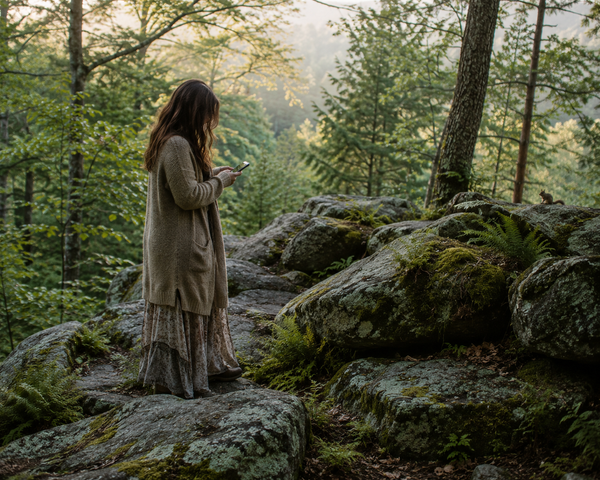
It was only after discovering these historical and mythological associations that I realized my own experience among the laurels belonged to a much older conversation. What occurred on that ridge was not, at least as I experienced it, the appearance of a portal. It was something subtler and far more difficult to describe.
The initial perception was not of a portal but through scrying/perceptual shifting/soft focus/open monitoring, an inhabited landscape seen at great distance became visible through the nested arches of the laurels. Maintaining attention caused the image to reorganize rather than enlarge. The distant landscape resolved into an iridescent lattice or mesh as I pulled it forward towards me, through which a curved path became visible. Rather than remaining remote, the path appeared to extend through the nearest arch and continue across the existing trail immediately in front of me. The experience was not primarily one of seeing another object, but of seeing a new continuity between the distant and the immediate.
As I continued looking through the laurels, a series of impressions arose with unusual force and coherence. They did not feel like deliberate thoughts. They presented themselves as knowledge. Whether that knowledge originated beyond me, emerged from my own unconscious, or represented some combination of both remains a question I cannot answer.
As I remained among the laurels, holding my attention upon the distant geometry that had begun to reveal itself through their interwoven branches, an unexpected memory emerged. It was not something I had consciously recalled in years. Rather, it seemed to awaken from somewhere beneath ordinary memory, as though the place itself had called it forth.
Years earlier I had dreamt of this same phenomenon.
In the dream, I did not remain outside attempting to understand it. I found a way through.
The entrance was not a door in any ordinary sense, but an alignment. Using the large boulders surrounding the ridge, I positioned myself at a particular angle and pushed through what appeared to be an invisible threshold embedded within the landscape itself. In doing so, I injured my ankle, though only slightly.
Someone was waiting for me on the other side.
They seemed neither surprised nor alarmed by my arrival. Instead, they regarded me with a kind of astonished admiration, remarking that it was extraordinary I had found my way into their world unaided and with so little injury. It was as though entry was possible, though exceedingly uncommon.
Almost immediately they noticed the poison ivy covering my skin and asked, almost casually, "You still haven't learned how to heal yourselves in your timeline?"
I replied that the poison ivy had been necessary. It had become part of the path by which I had arrived.
They smiled and answered that healing was ultimately a state of mind I had not yet learned to inhabit, though they could heal it for me if I wished.
I accepted.
Only much later within the dream did I begin to understand with a type of anomalous cognition that this place was not simply another location, but another ordering of reality. It appeared to exist alongside our own, not separate from it, as though another topology had been carefully overlaid upon the familiar landscape. Those who inhabited it possessed an understanding of time fundamentally different from ours. Time, for them, was neither fixed nor singular. It could be navigated, folded, and traversed through structures I understood as grids or fields constructed within the fabric of reality itself.
What I experienced there felt less like being shown inventions than being initiated into an entirely different ontology.
Yet knowledge carried consequence.
I came to understand that what was learned within their system could not always be carried unchanged back into ours. Knowledge itself altered relationships. To remove something from one order of reality was to disturb another.
Within the logic of the dream, poison ivy had not originally been poisonous. It was an ordinary plant that had become something else. In their world it served as a veil, a living boundary through which conversations could pass unheard by those who monitored the system. It concealed rather than harmed.
The retrocausal info transfer suggested that my participation in this knowledge somehow contributed to the transformation of the plant within my own world. The rash I carried became not merely an irritation of the skin, but the symbolic cost of crossing a boundary and returning with understanding that did not properly belong to me.
Whether this represented guilt, consequence, conservation, or something I still do not understand, I cannot say.
What remains remarkable to me is not the dream alone, but that while standing among the laurels years later, looking through the repeated arches that had so captivated my attention, this entire memory returned with extraordinary force. At that very moment, I was once again covered in poison ivy.
I do not offer this as evidence that another dimension exists, nor as proof that the dream described an objective reality. Rather, I record it because of the unusual coherence between the remembered dream, the geometry of the landscape, and the experience that unfolded before me. Whether these belong to the unconscious, to symbolic imagination, or to some deeper order of reality remains, for me, an open philosophical question.
It is tempting to imagine another world as existing elsewhere. Yet the experience resisted that image. Nothing suggested a distant realm separated from our own by astronomical distance. Rather, it appeared as though another order of reality occupied the same landscape under a different geometry of relationship. The laurels did not reveal a doorway so much as a continuity previously unnoticed, one that seemed to emerge through attention, alignment, and the peculiar architecture of living forms.
Conversations Across Traditions
Throughout the southern Appalachians, laurel thickets have long occupied a liminal place in regional imagination. They conceal paths, distort orientation, and create natural tunnels through otherwise impassable mountainsides. Stories of hidden hollows, fairy places, and landscapes where one might lose ordinary bearings cluster around environments of precisely this sort. My own experience neither confirms nor depends upon these traditions. Rather, I was struck by how an intensely personal experience unfolded within a landscape that folklore has long regarded as threshold-like.
laurel hell noun A dense growth of laurel (i.e. rhododendron)
1977 Hamilton Mountain Memories 48 Far back in the big mountains were the infamous “laurel hells” where our tall laurel grew so thick with twisted branches, that a man venturing in there might never find his way out.
c1980 Campbell Memories of Smoky 220 They soon learn, often with sore muscles as a lingering reminder, that the so-called “laurel slicks” of the Smokies are far from being “slick” and that “laurel hells” make a much more accurate or descriptive name for what the botanists know as “heath balds.”
When eighteenth-century surveyor Thomas Lewis first encountered the Blackwater River, he didn't reach for the language of geography but of mythology. Confronted by the dark waters and nearly impenetrable thickets of rhododendron and mountain laurel, he compared the place to the River Styx, the boundary between the world of the living and the dead.
He wrote:
"This River was called Styx from the dismal appearance of the place being sufficient to strike terror in any human creature, the laurels, ivy and spruce pine..."
Nearly three centuries later, naturalist Peter S. White (or Vanderhorst, depending on the source you're quoting) reflected upon the very same landscape with strikingly different words:
"Those are the places we call heaven."
Nothing about the mountains had changed. The laurels still arched over the river. The rhododendrons still formed nearly impenetrable tunnels. Yet the same landscape inspired two radically different realities. To one observer it suggested the entrance to the underworld. To another it revealed paradise.
This contrast raises a question that has quietly accompanied humanity for centuries. Do certain landscapes merely invite projection, allowing us to see what we bring with us? Or are there places whose very geometry has always invited experiences of threshold, hiddenness, and transformation?
Daphne
Long before Thomas Lewis compared Appalachian laurels to the River Styx, another laurel had already become one of Western civilization's enduring symbols of transformation.
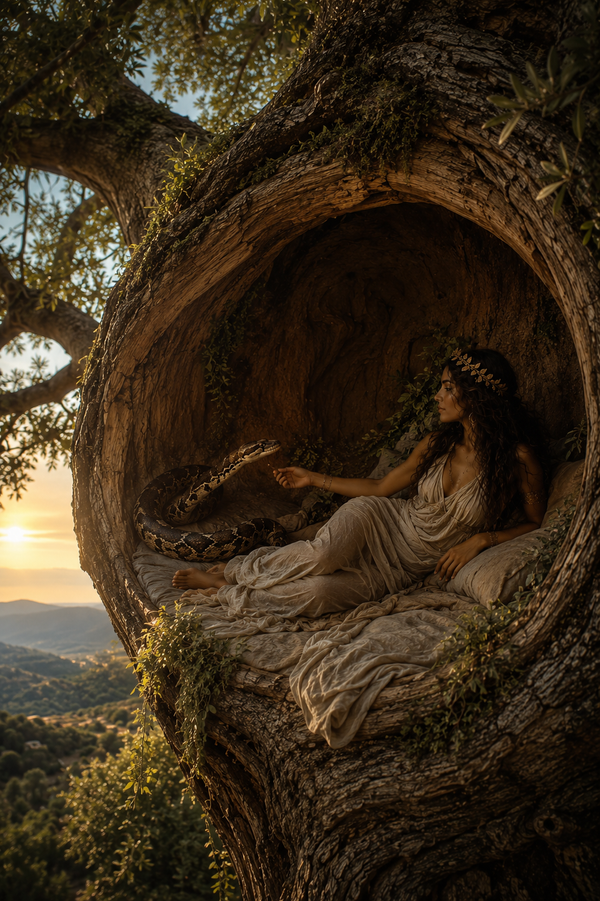
In Ovid's Metamorphoses, Daphne is not merely changed into a tree to escape Apollo. Her transformation establishes the laurel as a living witness between worlds. Though her human form disappears, Apollo continues to speak to her, crowns poets and prophets with her leaves, and consecrates the laurel as a symbol of inspiration and revelation.
The tree becomes neither wholly human nor merely botanical. It stands at the boundary between transformation and permanence, between speech and silence, between the earthly and the divine.