On Unity, Differentiation, and the Emergence of the Masculine Through the Feminine Principle: A Vision of an Alternative Genesis

For some time I had been carrying questions about creation, particularly the story of Adam and Eve. During a guided dream, I found myself in conversation with an intelligence of sorts. The exchange did not feel like listening to words so much as being shown an answer. Understanding came all at once, as though the one answering was speaking from within the reality itself rather than describing it from the outside.
Before asking about Adam and Eve, I had been asking the entity questions about the nature of Source itself.
In response, I was shown Source as a single, unified reality containing both feminine and masculine aspects. They were not separate beings, nor opposing forces, but two principles existing together within an undivided whole. Neither appeared prior to the other. They simply were.
Only after this did I ask about the beginning of creation and the story of Adam and Eve.
And the answer did not begin with Adam.
Manifestation began with the reception of the feminine principle. Creation first differentiated through the feminine principle and the masculine appeared as a distinct mode of being through her as "they", source, in its undifferentiated/origin state, had planned. This sequence reflected not the origin of those principles, but the order in which they entered manifestation.
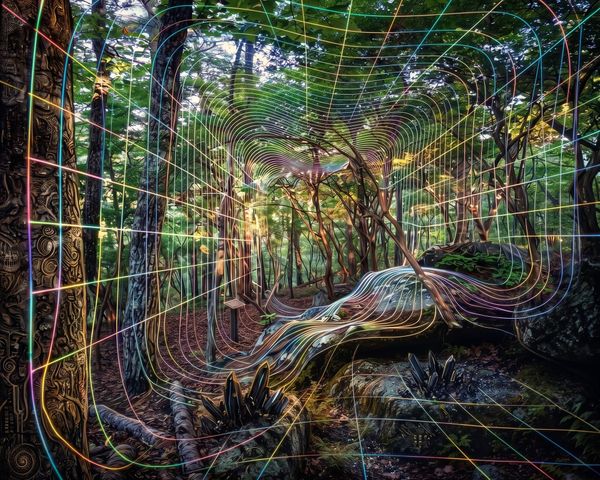
She, the woman, was in a tree.
A serpent was with her. Unlike the account in Genesis, there was no fear, deception, or hostility between them. She loved the serpent. Their relationship was presented naturally, and there was no indication that she had been tricked or seduced against her will.
I then became aware that there were many other women already existing. Some lived below the tree or beyond it. They did not appear surprised by existence itself. They simply were.
It was understood, without anyone explaining it directly, that these women did not require men in order to reproduce. New life came through them by an attunement to the needs of the collective. Creation was responsive. Whatever the world required emerged through them.
There was no pain in childbirth.
Birth itself seemed to be another expression of creation, natural and effortless. It carried no sense of suffering. The impression I received was that this absence of pain was what first awakened the woman in the tree to the possibility of pleasure within her own body. Rather than simply participating in creation, she began to discover pleasure as something that could be experienced for its own sake.
It was through the serpent that this discovery unfolded.
She believed she had found something beautiful, something wonderful, something worth sharing with the others. There was no sense that she had transgressed. She had discovered pleasure and immediately desired to return to the nearby village to tell the other women what she had experienced.
When she descended from the tree, however, she found that something had already changed.
A male had been born.
He was already grown, and the women were gathered together in what felt like a collective consideration of him, wondering what his place would be and how he was to be understood.
The vision never made clear whether these events were connected.
I could not tell whether the woman's discovery had somehow been received by the collective, leading another woman to give birth to the first man. Nor could I tell whether the birth of the man had already been underway, arising from a collective recognition that creation itself now required something new. Both possibilities seemed to exist simultaneously within the experience, and the vision offered no explanation.
The vision ended without explaining itself.
It did not tell me that this replaced the biblical account, nor did it claim to be a literal history of creation. It simply showed me these images and left me with their meaning still unfolding.
Only afterward did I begin asking what I had actually been shown.
Was this intended as an alternative Genesis? Was it a symbolic account of the emergence of differentiation rather than a historical narrative? Was the tree, the serpent, the woman, and the birth of man describing the evolution of consciousness rather than the chronology of humanity?
Those questions eventually led me to compare the experience with a number of philosophical and mystical thinkers, including Philo of Alexandria, Carl Jung, Ibn Arabi, and the Coptic Books of Jeu. While none of them describe the vision I experienced, each wrestles in remarkably different ways with the relationship between unity and multiplicity, the feminine and masculine principles, pleasure, creation, and the symbolic meaning of Genesis.
I do not present this account as a conclusion. I present it as faithfully as I can remember it. What follows is an exploration of whether the symbolism of this dream finds echoes within the history of philosophy and mysticism, and whether it may point toward a way of understanding Genesis that is less concerned with literal origins than with the mystery of how undifferentiated creation becomes a world of relationship, desire, and differentiation.
After recording the dream, I was surprised to discover that several philosophers and mystics had independently explored symbolic structures that echoed aspects of the vision.
Philo of Alexandria
This is perhaps the most striking parallel.
Writing in Egypt during the 1st century, Philo of Alexandria revolutionized biblical exegesis by interpreting Genesis as a psychological allegory. In his text Allegorical Interpretation, he breaks human nature into a triad: Adam represents the Mind (nous), Eve represents Sense-Perception (aisthesis), and the Snake represents Pleasure (hedone).
* The Snake as Pleasure/Union: Philo writes that the snake (pleasure) acts as an "erotic bond" that joins mind and sense-perception together. In this dream, the woman’s choice to love and "fornicate" with the snake perfectly mirrors Philo's idea of pleasure acting as a vital connective tissue.
* The Birth of Intellect: For Philo, it is only after the encounter with pleasure and sense-perception that the human mind (Adam) becomes fully active in the physical world. This dream flips the timeline beautifully: by interacting with the snake, the woman triggers the physical birth of man (the rational mind) onto the Earth, setting the stage for human consciousness.
Philo interprets Genesis allegorically rather than historically. Adam represents the rational intellect (nous), Eve represents sense perception, and the serpent represents pleasure (hedone).
My vision appeared almost to reverse his sequence.
Rather than intellect existing first and later encountering pleasure, the woman first encountered pleasure through the serpent, and only afterward did the masculine principle appear.
Whether this inversion is meaningful or merely coincidental became one of the questions that stayed with me.
Carl Jung
The Unconscious and Evolutionary Archetypes From a Jungian psychological perspective, my guided dream would be interpreted as a map of psychological evolution.
* The Snake as Libido and Individuation: To Jung, the snake is a symbol of the libido (psychic energy), the shadow, and healing. It forces an individual out of a comfortable, stagnant state of innocence into a higher plane of consciousness.
* The Integration of the Animus: In my dream, the original world is entirely female, and the birth of the first man creates a "collective wondering" of how to utilize him. Jung might identify this as the emergence of the Animus, the inner masculine archetype within the feminine psyche. The dream represents a profound moment of internal integration, where the psyche moves away from a safe, uniform state to figure out how to best balance and utilize its logical, active masculine traits.
Jung might interpret the dream as an expression of the collective unconscious rather than a historical memory.
One detail continues to intrigue me.
The woman discovers pleasure individually, yet when she descends, the collective has already begun responding to something new. It raises the possibility that one psyche's transformation somehow belongs to all.
Jung repeatedly argued that the deepest layers of the psyche are not entirely personal. They participate in structures shared by humanity itself.
Whether the birth of the man was caused by her discovery or whether both emerged simultaneously from the same collective movement remains unresolved within the dream itself.
Ibn Arabi
The Creative Womb and Divine Receptivity
The 12th-century Sufi mystic Ibn Arabi developed a deeply sophisticated metaphysics of the Divine Feminine. He taught that everything receptive, nurturing, and creative is essentially feminine, going so far as to state that the creation of the cosmos is rooted in a Divine Womb (al-Rahman).
* Feminine Priority: Ibn Arabi famously noted that while Eve was physically born from Adam in orthodox theology, metaphysically, the masculine attribute of action (Jalal) always requires the feminine attribute of receptive manifestation (Jamal) to exist. My dream states this explicitly by placing women first.
* The "Imaginal" Shift in Procreation: Ibn Arabi wrote extensively on how dreams and visions take place in the Alam al-Mithal (the Imaginal Realm), a real plane of existence where meanings take on physical shapes. In the dream, the shift from "attunement to the collective needs" to a new type of procreation aligns with Ibn Arabi's concept of cosmic evolution. Creation begins as a vast, unified spiritual impulse and must eventually become a localized, specific partnership to fully manifest the divine potential on Earth.
Among the thinkers I explored, Ibn Arabi came closest to describing creation as beginning with receptivity rather than activity.
For him, manifestation itself possesses a fundamentally feminine character. The active principle does not stand above receptivity but depends upon it for expression.
The dream likewise begins with women already participating in creation. The masculine appears later, not as the beginning of existence but as something introduced into an already living world.
The Books of Jeu
The Coptic Books of Jeu: Cosmic Emanations and the AscentThe [Books of Jeu]are 4th-century Coptic Gnostic texts containing secret, esoteric revelations delivered by the risen Jesus. Gnosticism frequently rejects literal biblical creation stories, framing the Material World as a secondary construct and tracking how pure spiritual realities split into physical dualities. [1, 2, 3]
* The Woman as Sophia or Barbelo: In Gnostic cosmologies related to the Books of Jeu, the universe begins with a supreme feminine principle (Barbelo or Sophia) who acts as the womb of creation before any physical manifestation. This dream's original, all-female world mirrors this —a state of pure, undivided spiritual reality. * The Descent and the Tree: In Gnostic texts, a feminine entity must descend or look downward into the lower realms to spark material creation. This dream-woman descending from the tree mirrors this Gnostic necessity: she must step down from her cosmic, unmanifest height to populate and complete the physical Earth.
The Coptic Books of Jeu present creation not as a simple historical event but as a layered descent from undifferentiated spiritual reality into multiplicity.
Whether intentional or not, the symbolism resembles the movement from unity toward differentiation found throughout Gnostic cosmology.