The Layered Present: Notes on Recursive Consciousness

I had not been writing for some time. For a couple of months, the work had gone quiet. The questions I had been carrying since earlier years felt suspended rather than resolved.
That changed during an altered state.
I attempted to write a note to myself. The intention was to record a question about schizophrenia, perception, and whether consciousness might experience reality differently under certain conditions.
Later, when I reviewed what I had written, I found an additional line that I do not recall intentionally writing:
“I’m watching. Can’t interfere.”
I do not remember writing it.
What struck me was not the sentence (though certainly thought provoking and enticing) itself but what followed immediately after reading it.
I remembered. I didn't remember an idea or writing this note, but a dream.
Immediately upon reading it, I recalled an older dream involving communication with a future version of myself through technology and a figure I had understood as an administrator, observer, or intermediary presence.
In the dream, I was attempting to understand the limits of interaction across time and questioned this authority regarding what could and could not be done. Communication, I was told, remained possible through certain channels, among them technology and animals, while direct intervention was constrained.
What startled me was not simply the resemblance of the message to the dream's themes and setting. I recalled having left this precise message:
"I’m watching. Can't interfere."
The memory did not arise as interpretation but as recollection. The phrase seemed familiar before I had time to consider its meaning. Whether this was memory, association, reconstruction, or something else remains an open question. What remains true is the sequence itself: I read the sentence, and the dream returned.
After this recall, I went to a trail I frequently walk.
While at the pond area on the trail, I observed an otter. This was unusual enough on its own. I had walked these trails for over a year and had never seen one there before or much of any animal activity.
I remained for some time watching it and attempting to photograph it.
At one point a woman stopped with two dogs. We stood together for perhaps ten minutes attempting to capture photographs. Despite our efforts, neither of us managed to get a close image. She eventually continued on her way.
What stood out to me was that the otter had come considerably closer before her arrival and would do so again after she left even though we were in silence together and alone I was speaking quietly to it, and in those moments it moved closer toward the bank.
Then, a mother and daughter passed nearby with a dog. I attempted to point out the otter's presence, but they seemed not to hear or see me and continued on.
Later, an older couple walked past. I pointed toward the water and attempted to show them where it was. They looked, but could not see it.
Individually, none of these moments would have held much significance. Together, however, they contributed to a growing impression that the encounter existed in an unusual relationship to attention itself.
The otter was visible. Yet it seemed repeatedly to occupy the edge of visibility.
Present, but difficult to share.
Observable, but resistant to being fixed into image.
While watching the otter, additional portions of the same dream began to return.
What first appeared as an isolated recollection now felt connected to a larger structure of memory. The animal encounter did not seem to create the memory so much as uncover another layer of it.
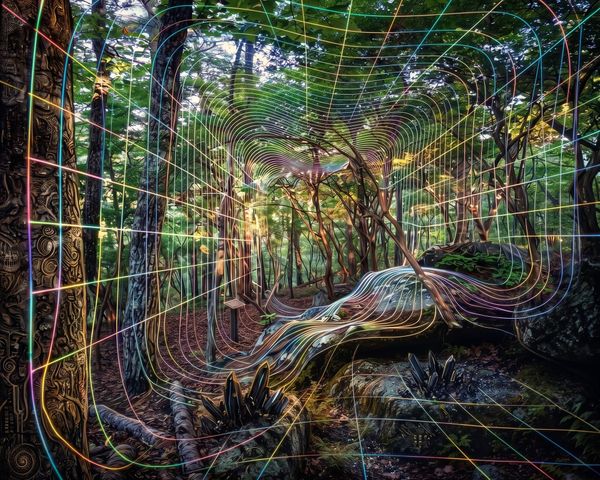
I recalled the otter as part of the dream itself. In the dream there had been a sense that it existed behind a kind of veil. Not hidden exactly, nor absent, but partially inaccessible. Present and observable, yet separated by something difficult to describe.
The image that returned was not of complete concealment but of partial disclosure. I remember a rainbow-like quality to the veil, as though the animal occupied a threshold between visibility and obscurity. It could be seen, but not fully grasped. Encountered, but not possessed.
Standing at the pond, I found myself remembering this before I had attached any interpretation to what was happening around me.
The dream didn't return all at once but in pieces.
The note came first and then the recollection of the administrator and the message.
Then the otter followed by the memory of the veil.
The recollection arrived before I had attached any meaning to the experience.
I simply remembered.
It was at this point that the field of attention shifted. What had been primarily internal: note, recall, dream fragments, and the otter, began to rejoin ordinary perception in a more immediate way, as though the structure of the day was no longer only being remembered but also being actively lived forward.
A man I had encountered previously on another day walked up one of the three trails joined at this location. His presence had made me uncomfortable during the earlier encounter, and that response returned as soon as I saw him again.
After he passed, I decided to leave the area and head back to my car. I did not want him returning behind me. I felt relief when, around the same time, an older couple walked back down the trail while the man continued further up it. The movement of others reduced the uncertainty of the moment, and I took it as an opportunity to continue on my way as I normally would.
While on this familiar section of trail, I heard something behind me. I turned and saw it was this man. As he got closer behind me, I turned briefly and smiled in order to ease the tension I felt. At that moment, he said something to the effect of his dog wanting him to follow me.
When he spoke to his dog, his tone and body language registered to me as unusually sharp and directed. The way he looked in my direction while speaking created a sense of unease, as if the interaction with the dog was being used as a framing device rather than a neutral exchange.
I noticed myself reading the moment as loaded, though I cannot separate with certainty what was objectively present from what I was already carrying from earlier encounters on the trail.
What I can say is that my perception of the exchange increased my sense of alertness and contributed to my decision-making as I continued forward.
He was stopped at a junction/shortcut between routes, where he appeared to have assumed I would take the longer, but connected trail. Instead, I chose a less used, more scarce route, one I'd never noticed or traveled before.
After this interaction, I continued forward on the new trail system. I experienced a sense of recognition and recalled again a prior dream in which I was moving along an unfamiliar path as to avoid a man. In the dream, I initially chose a lesser-known route rather than the familiar one. After some distance, I became uncertain and turned back toward a more known direction. Upon doing so, I encountered the same man-like presence positioned as if he had been waiting. When I attempted to move again, there was a sense of pursuit as I tried to return through the unfamiliar path.
In the waking realm, I did not turn back. I continued through the unfamiliar trail until it reconnected with a known route.
The sequence of the day felt continuous: the written note, the recall of earlier dreams, the otter encounter, the trail decision, and the subsequent memory recall forming a connected chain of perception and memory.
At a certain point, the experience itself became indistinguishable from reflection on the memories it brought forward. What had been lived sequence began to function as pattern.
The sequence described above is not presented as interpretation added after the fact, but as a record of how perception and memory appeared to interleave during the day itself.
At multiple points, lived experience and recall did not remain separate processes. Instead, perception seemed to trigger structured memory retrieval, and memory in turn altered the way present events were attended to.
Rather than isolated events, the day appeared to unfold through recursive activation of memory within perception.
I experienced reality as if it were structured through recursive recall, and I am comparing that felt structure to historical systems that also model invisible flow.
It is from this experiential pattern that the following comparative model emerges, not as explanation of the events, but as a reflection on the structural similarity between how meaning was experienced internally and how structured systems represent unseen processes externally.
"Reality is governed by hidden layers of intelligible structure, and symbols allow interaction with it.”
Convergent Structure Mapping
| Theme | Solomon tradition | Gnostic systems | Modern AI systems |
|---|---|---|---|
| Hidden authority | King commanding spirits | Aeons / rulers of realms | Model governance layers |
| Symbols | Seals / sigils of control | Names, glyphs, ritual diagrams | Tokens, embeddings, code |
| Structure | Hierarchy of commanded forces | Layered heavens / realms | Layered neural architecture |
| Interaction method | Invocation / command | Ritual ascent / knowledge keys | Input → processing → output |
| “Entities” | Spirits / demons | Aeons / archons | Emergent behaviors / modules |
| Purpose | Control unseen forces | Transcend / understand reality | Generate / transform information |
Humans repeatedly reinvent structured models of unseen causality using the most advanced metaphor available in their era.
When examining systems such as the Coptic Gospel of Jeu material, Solomonic diagrams, or medieval ritual seals, certain recurring visual and structural features appear:
- radial symmetry (circles, hubs, mandalas)
- branching lines or “paths”
- repeated geometric nodes
- enclosed systems with defined boundaries
- layered compartments or zones
- symbolic connection points (names, letters, marks)
When placed alongside modern computational architecture, particularly microchip design, a parallel structural logic appears:
- a central processing core (hub)
- branching circuitry for signal routing
- layered architecture (silicon/logical strata)
- repeating grids (transistors)
- bounded physical enclosure (chip package)
- controlled pathways for electrical/informational flow
In both cases, the underlying problem being solved is not symbolic but structural:
How does one organize and regulate invisible flow within a constrained system?
From this perspective, the resemblance between ritual diagram, cosmological schema, and computational architecture can be understood as a form of convergent structure: different domains producing similar spatial-logical forms because they are modeling similar constraints on flow, relation, and control.
The notion of convergent structure does not require that these systems be historically or causally linked. Rather, it suggests that human cognition repeatedly generates similar formal models when attempting to represent organized, invisible processes.
Within earlier metaphysical traditions, this impulse appears in different language.
Philo of Alexandria describes reality as structured through Logos, an ordering principle through which intelligibility is maintained. In his framework, what appears fragmented at the level of perception is unified at the level of underlying rational structure. The emphasis is not on symbolic similarity between systems, but on the existence of an intelligible pattern beneath variation.
In a different register, Ibn ʿArabi develops a model of layered reality in which meaning takes form within an intermediate domain (ʿālam al-mithāl), where perception is structured but not strictly material. In this account, forms are neither purely mental nor purely physical, but arise within a mediating field in which meaning becomes perceptible as shape.
Neither framework anticipates technological systems such as computational architecture. However, both offer a way of thinking about structured mediation: systems in which unseen processes become legible through form, relation, and constraint.
Taken together, these frameworks do not predict or describe modern computational systems.
However, they do offer language for thinking about structured mediation itself:
systems in which unseen processes become intelligible through form, relation, and constraint.
Read in this way, the recurrence of diagrammatic, cosmological, ritual, and computational structures does not point to hidden historical continuity, but to a repeated human tendency: to render the invisible legible through structure.